
Personal Branding on LinkedIn for Founders: A 2026 Playbook

Repost On:
A lot of founders approach LinkedIn the same way: post the occasional motivational quote, share a generic “leadership lesson,” maybe repost a company announcement, and hope something sticks. That kind of personal branding on LinkedIn for founder doesn’t work.
Not because the LinkedIn algorithm doesn’t work, but because that kind of content doesn’t actually build a brand. It’s forgettable, interchangeable with thousands of similar posts, and gives someone reading it no real reason to remember who wrote it.
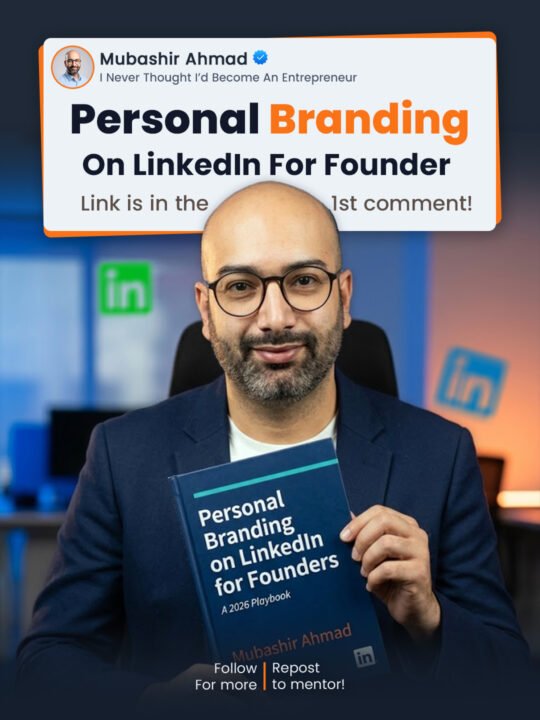
This article lays out a practical approach to building a founder’s personal brand on LinkedIn in 2026 — one built around actual differentiation and real inbound interest, not generic thought-leadership filler.
Table of Contents
Why Generic Founder Content Fails?
Before getting into what works, it’s worth understanding specifically why the common approach doesn’t.
The Interchangeability Problem
Most generic “leadership lesson” or “here’s what I learned about business” posts could have been written by almost any founder, in almost any industry. There’s nothing in the content itself tying it specifically to the person who wrote it — no real detail, no specific experience, no distinct point of view.
Why This Matters More Than It Seems?
Content that could be written by anyone gives a reader no reason to follow, remember, or eventually reach out to the specific person who posted it. It might get a handful of polite likes, but it doesn’t build the kind of recognition that turns into a business relationship later.
The Selling-Too-Hard Problem
The opposite mistake is just as common: founders who treat every single post as a pitch, ending each one with a call to book a call or check out their product. This burns out an audience quickly — people can tell the difference between content meant to genuinely help or inform, and content that exists purely to extract a sale.
The Foundation: Pick a Specific Lane
The single most important decision in building a personal brand is choosing what you’re actually going to be known for — and it needs to be narrower than most founders initially want it to be.
Why Narrow Beats Broad?
The Algorithm Reads Consistency
LinkedIn’s systems increasingly understand accounts by the topics they consistently post about. A founder who posts about product strategy, hiring, marketing, and industry news all in the same week gives the algorithm — and human readers — a much less clear signal of what to expect and who to show the content to, compared to someone who consistently covers two or three specific areas.
Humans Remember Specificity, Not Range
A reader is far more likely to remember “the founder who talks about pricing strategy for SaaS companies” than “the founder who posts about various business topics.” Specificity is what makes someone memorable enough to think of when they actually need help with that exact thing.
How to Actually Choose Your Lane?
- Identify two or three areas where you have genuine, specific experience — not just general interest.
- Check that these areas overlap meaningfully with what your actual business or expertise addresses, so the content naturally supports business goals.
- Resist the urge to cover “everything you know” — a narrower, more consistent focus builds recognition faster than broad, scattered coverage.
The Content That Actually Works: Real Stories Over Generic Advice
Once the topic focus is set, the next decision is what to actually say about it — and the evidence consistently points toward real, specific experience over generic advice.
Why Case Studies and Real Stories Outperform?
- They can’t be copied. Generic advice (“communication is key to good leadership”) could be posted by anyone. A specific story about a real decision, a real mistake, or a real client outcome is inherently unique to the person who lived it.
- They demonstrate rather than claim. Saying “I’m good at fixing underperforming websites” is a claim. Describing the actual process of diagnosing and fixing one is proof.
- They give the algorithm a stronger engagement signal. Specific stories tend to generate more genuine comments and saves than generic advice, because readers have something concrete to respond to.
A Simple Story Structure That Works Consistently
- The situation — what the problem or starting point actually was, described specifically.
- What almost everyone assumes the fix is — this is often where a contrarian or unexpected angle comes in.
- What actually happened — the real intervention or decision.
- The result — ideally with a real, specific number or outcome.
- What it means for the reader — a brief takeaway connecting the story back to something useful for someone in a similar position.
Building Trust Without Selling Constantly
A personal brand that converts into real business relationships needs to balance genuine value with occasional, clear opportunities to work together — and getting that balance wrong in either direction undermines the whole effort.
The Soft-CTA Approach
- Most posts should stand entirely on their own value — useful, interesting, or specific enough that a reader gets something out of it regardless of whether they ever reach out.
- A smaller portion of posts — roughly one in four or five — can carry a clear, low-pressure invitation: a comment prompt, a DM invitation, or a direct mention of what you offer.
- Occasionally, a single, plainly-worded “here’s what I actually do” post, ideally pinned to the profile, ensures anyone genuinely interested has a clear next step without every other post needing to carry that weight.
Why Constant Selling Backfires Specifically for Founders?
A founder’s personal brand carries more implicit trust than a company account, precisely because it feels like it’s coming from a real, specific person rather than a marketing department.
Overselling erodes exactly the quality that makes a personal brand valuable in the first place — the sense that the person is sharing something genuine, not performing a sales funnel.
Profile Fundamentals Founders Often Overlook
Content strategy matters, but a strong post sending someone to a weak, outdated, or unclear profile undoes much of that work.
What to Get Right?
- A clear, professional photo and a banner that reflects what you actually do, not a generic stock graphic
- A headline stating specific expertise or value, not just a job title
- An About section written in first person, telling a real story rather than reading like a resume
- A Featured section highlighting genuinely strong case studies or posts, kept current
- Recommendations from real clients or colleagues, ideally reasonably recent ones
Building an International Audience
For founders building a personal brand aimed at clients or partners across different countries and time zones, a few additional considerations matter.
Communication Signals Matter More Across Borders
- Fluent, clear, professional English communication is itself a differentiator when competing for attention and trust from an international audience.
- Being explicit about working-hour overlap with a target region — for example, noting availability during US or European business hours — removes a common hesitation before it’s even raised.
- Case studies and examples that reflect a range of client contexts, rather than a single narrow market, help a broader international audience see themselves in the work being described.
Consistency Matters Even More When Building Trust Remotely
When a potential client can’t rely on local reputation or in-person referrals, consistent, specific, genuinely useful content becomes one of the primary ways trust gets built before any direct conversation happens. This makes the “real stories over generic advice” principle even more important for founders working across borders than for those relying primarily on local networks.
Common Mistakes Founders Make on LinkedIn
Even founders who understand the general principles above tend to fall into a handful of specific, avoidable habits.
- Ghostwriting that sounds nothing like the founder. Outsourced content that reads as generic or overly polished often undermines the personal, specific quality that makes founder content valuable in the first place. Any ghostwriting arrangement should be built around the founder’s actual voice, experiences, and opinions, not a generic template.
- Posting only company wins, never real challenges or lessons. A feed that only ever shares good news reads as a highlight reel, not a genuine perspective, and tends to generate far less real engagement than posts that include honest difficulty or a real mistake.
- Disappearing during busy periods. It’s common for founders to post consistently for a few weeks, then go silent for a month when the business gets busy — which resets the consistency signal both the algorithm and human followers rely on.
- Engaging only when posting, never otherwise. A founder who only shows up on LinkedIn to publish their own content, without ever commenting on or engaging with others’, misses a significant portion of the relationship-building that drives real inbound interest.
- Copying another founder’s voice or format too closely. Studying what works for others is useful; directly imitating a specific well-known founder’s tone or structure tends to read as derivative rather than authentic, and works against the entire goal of standing out.
A Practical Fix for Consistency
Building a simple, realistic content system — even a basic list of story ideas and a fixed weekly posting slot — tends to solve most of the consistency problems above more effectively than relying on motivation alone. Founders who treat content as a scheduled part of the week, similar to any other recurring business task, are far more likely to sustain the habit through busy periods than those who post only when inspiration strikes.
A Realistic Timeline
Personal branding on LinkedIn is frequently judged too early. A month of consistent, well-targeted posting is unlikely to produce a flood of inbound leads — but it’s a reasonable amount of time to expect meaningful growth in profile views, genuine engagement, and early DM conversations.
The businesses that see the strongest long-term results tend to be the ones who treat this as a sustained habit measured over several months, not a short campaign measured over a few weeks.
Frequently Asked Questions
How often should a founder post on LinkedIn?
Three to five times per week tends to build consistency without overwhelming an audience, enough to stay visible without becoming repetitive to the same followers.
Should I use my personal profile or my company’s LinkedIn page?
For most founders, a personal profile builds organic reach and trust far more effectively than a company page, which typically sees a much lower organic reach on this platform.
What if I don’t have dramatic client stories to share yet?
Smaller, specific stories still work, a minor but real improvement, a small mistake and what it taught you, or a genuine observation from ongoing work all outperform generic advice, even without a dramatic outcome attached.
How do I know if my content is too promotional?
A reasonable check is whether the post would still be useful or interesting to someone who never intends to hire you. If every post exists purely to generate a sale, it’s likely tipping too far toward promotional.
Is it worth posting in multiple languages for an international audience?
For most founders targeting English-speaking markets specifically, consistent, high-quality English content is usually a stronger investment than splitting effort across multiple languages, unless a specific non-English market is a clear priority.
How long before personal branding on LinkedIn produces real leads?
Most founders see meaningful engagement growth within one to three months of consistent posting, with inbound leads typically following as trust and recognition build over a longer period, often several months.
Key Takeaways: Personal Branding on LinkedIn
- Generic, interchangeable content fails to build a memorable personal brand — specificity is what makes a founder recognizable.
- Choosing a narrow, consistent topic focus helps both human readers and the algorithm understand what to expect.
- Real stories and case studies consistently outperform generic advice because they can’t be copied and demonstrate expertise rather than just claiming it.
- A sustainable content strategy uses soft CTAs sparingly, letting most posts stand on genuine value alone.
- Profile fundamentals matter as much as content strategy — a strong post shouldn’t lead to a weak profile.
- Founders building an international audience benefit from explicitly signaling communication quality and time-zone overlap.
Building a founder’s personal brand on LinkedIn isn’t about performing expertise loudly. It’s about being specific, consistent, and honest about real work done often enough, and for long enough, that the right people start to notice.
